Do you want the best headset?
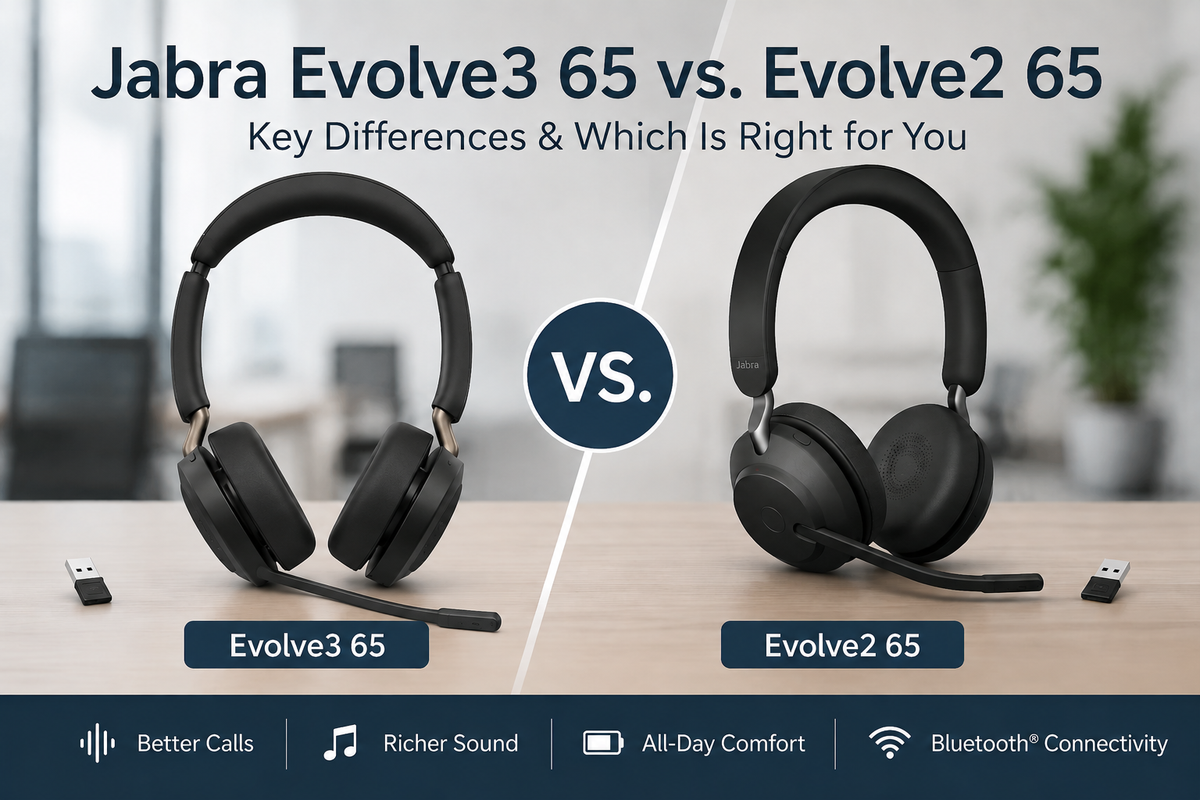
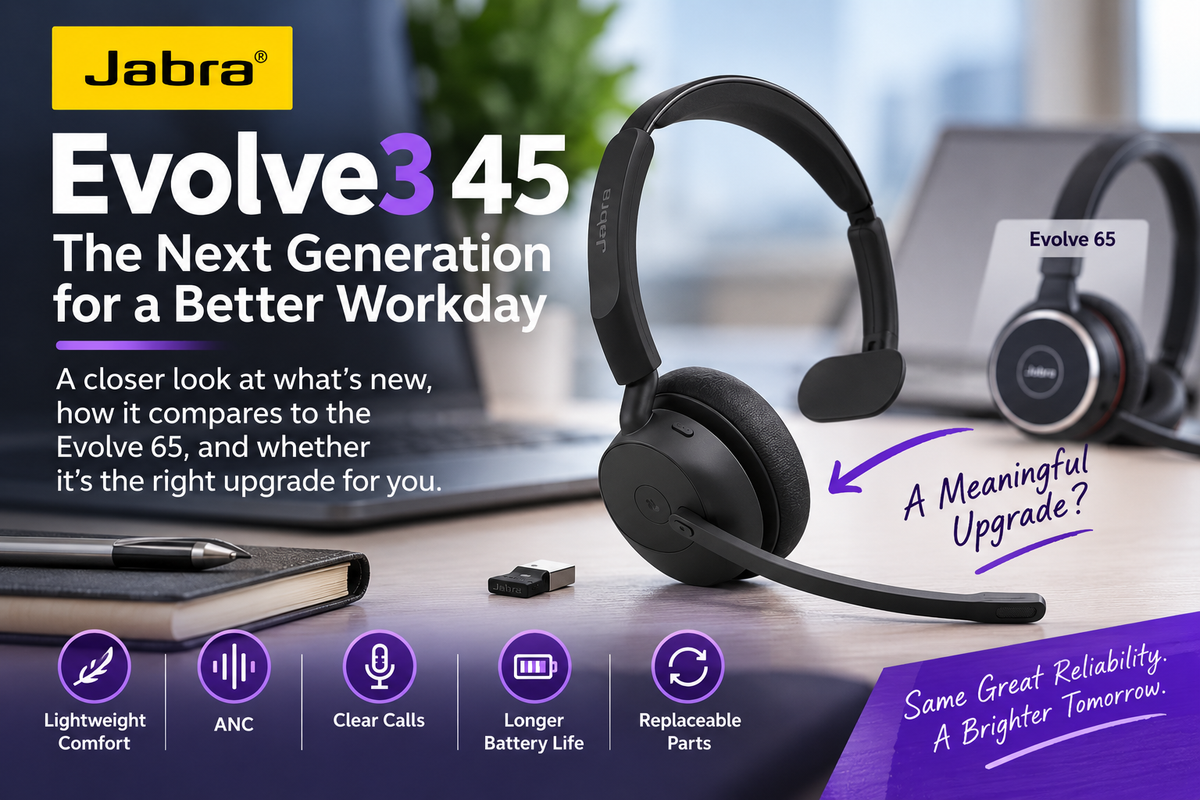
The Jabra Evolve2 65 has been one of Jabra's more popular wireless business headsets, so when a replacement comes along, the obvious question isn't simply whether the new model is better.
The more useful question is: if you already own an Evolve2 65, are the improvements in the new Jabra Evolve3 65 significant enough to justify upgrading?
Jabra changed quite a bit with this new generation. The Evolve3 65 gets an updated microphone system, adaptive Active Noise Cancellation (ANC), improved comfort, a reversible microphone boom, newer Bluetooth technology, upgraded audio and customer replaceable components.
Those are meaningful changes. But that doesn't automatically mean you should replace a perfectly good Evolve2 65.
In this blog, we'll look at what's actually changed, which improvements are likely to matter most in everyday use, and when keeping your Evolve2 65 may make more sense than upgrading.
Jabra Evolve3 65 vs. Evolve2 65: What's Changed?
Before getting into the individual differences, here's a quick overview of some of the key changes between these two generations.

One thing that becomes apparent is that the Evolve3 65 isn't simply an Evolve2 65 with a different appearance.
Jabra has made changes in several areas that can affect everyday use, including microphone performance, ANC, comfort, audio, connectivity and long-term ownership.
Whether those improvements are important enough for you to upgrade is another question.
Let's start with one of the biggest changes.
The Evolve3 65 Gets a New Three-Microphone ClearVoice System
For a business headset designed primarily around calls and meetings, microphone performance should be near the top of your list if you’re looking for a new headset.
Jabra upgraded the Evolve3 65 with its new three-microphone ClearVoice technology, which is specifically designed for voice pickup in busy and noisy working environments. Jabra is positioning microphone performance as one of the biggest improvements compared with the previous Evolve2 generation.
Claims about microphone noise cancellation are easy to make, but hearing the difference is more useful.
That's why in our video we tested the Evolve3 65 against the Evolve2 65 using the same background sounds. The video includes tests in a quiet environment as well as more challenging background noise so you can hear the difference for yourself rather than relying on a specification sheet.
And remember what microphone noise cancellation is actually trying to accomplish.
It's not attempting to reduce the noise you hear. It's trying to keep the person on the other end of your call from hearing what's happening around you.
If you work in a quiet private office, improvements in microphone noise cancellation may not be a compelling reason to replace an Evolve2 65 that's working perfectly well.
If you're taking calls around coworkers, conversations, children, pets or other distracting sounds, improved microphone performance can become considerably more important.
There's another option worth mentioning here.
If you like your Evolve2 65 and background noise is the main reason you're considering replacing it, you don't necessarily have to replace the headset. That’s because there’s noise canceling software, like neep, that can add another layer of software-based microphone noise cancellation to the audio device you're already using. neep also removes far end noise as well, which is something no headset can do. neep is covered in the video as another way of addressing background noise without having to replace your hardware.
That can be worth considering if the Evolve2 65 is otherwise still doing everything you need.
[IMAGE SUGGESTION: Evolve3 65 microphone close-up or a person using it in a moderately noisy office. Keep text minimal or use no text.]
Adaptive ANC Is a More Significant Upgrade Than It May Sound
The Evolve3 65 also adds adaptive Active Noise Cancellation.
ANC addresses the other side of the noise problem. Instead of reducing the background noise your caller hears, ANC helps reduce the distracting sound you hear while wearing the headset.
And there's an important improvement compared with the Evolve2 65: ANC on the Evolve3 65 can be used during calls.
That's a meaningful distinction for someone who spends a large portion of the day talking rather than simply using ANC between calls.
The Evolve3 65 also includes HearThrough mode. This does essentially the opposite of ANC by allowing more of your surrounding sound through when you want greater awareness of what's happening around you.
For example, if a coworker walks over to ask you a question, HearThrough can allow you to have that conversation without taking the headset off.
ANC, HearThrough and microphone noise cancellation are sometimes lumped together, but they perform different jobs.
ANC helps reduce what you hear. The ClearVoice microphone system helps reduce what your caller hears. HearThrough lets more surrounding sound in when you want it.
If you work around noise, having control over both sides of the conversation is one of the stronger reasons to consider the Jabra Evolve3 65.
You Can Finally Wear the Microphone on Either Side
This may not sound like a major technological breakthrough, but it's something Jabra customers have wanted for years.
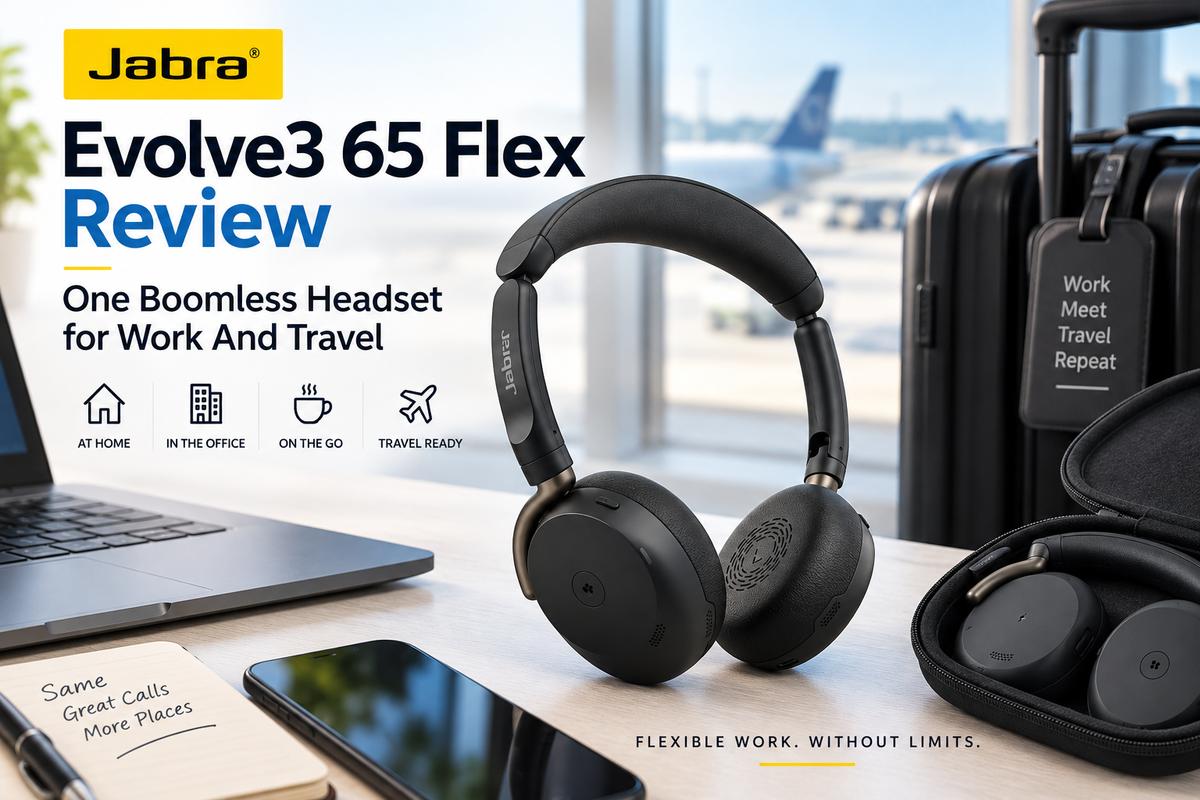
The Evolve3 65 microphone boom rotates 270 degrees, allowing you to position the microphone on either the left or right side of your face.
For someone who doesn't care which side the microphone is on, this isn't going to influence an upgrade decision.
For someone who strongly prefers the microphone on a particular side, it's a very welcome change.
Jabra also retained one of the features we like on business headsets: flip-to-mute.
Raise the microphone boom and your microphone mutes. Bring it back down and you're ready to talk again.
That's a small feature until you're in the middle of a call and suddenly need to mute yourself. Then it's considerably more convenient than searching for a button.

Jabra Put More Attention Into All-Day Comfort
Comfort can be difficult to evaluate from a specification sheet because everyone has different preferences, which makes comfort very subjective.
But Jabra clearly made it an area of focus with the Evolve3 65.
The new model uses Jabra's AirComfort technology, which is intended to provide a lighter, more balanced fit with less pressure during long workdays. The dual-speaker Evolve3 65 weighs approximately 131 grams (4.6 ounces), which by dual speaker standards is on the lighter side.
If you wear your headset for 30 minutes at a time, modest improvements in pressure and weight may not be particularly important.
Wear it for six or seven hours and your priorities can change.
It's also worth remembering that the Evolve3 65 remains an on-ear headset. The cushions rest against your ears rather than surrounding them. Some people prefer on-ear headsets because they're generally less bulky, while others simply find an over-ear design more comfortable.
The Evolve3 65's improved comfort design doesn't change that basic wearing style.
So if your biggest complaint about the Evolve2 65 is that you simply don't like on-ear headsets, moving to another on-ear headset won’t solve your problem. You might be better served by looking at an over-ear alternative. Some headsets today offer over-ear cushions as an optional accessory, like the EPOS Impact 1000 for example. This allows you to select the style of ear cushions that work best for you.
So if you like the basic Evolve2 65 wearing style but want something more refined for extended use, you’ll probably find the Evolve3 65 to be a better solution.
Audio Gets an Upgrade Too
Business headsets are primarily communication tools, but many people now use the same headset for casual calls, music, videos and other media throughout the day.
Jabra appears to be paying more attention to that broader use.
The Evolve3 65 uses 28 mm speakers with super wideband audio for clearer, more natural-sounding calls, along with enhanced audio for music and other listening. The headset remains focused on business communications, but Jabra is also putting greater emphasis on the listening experience between calls.
Will that alone convince most Evolve2 65 owners to upgrade?
Probably not.
But when combined with the microphone, ANC and comfort changes, better audio becomes another part of the overall improvement rather than the sole reason for replacing your headset.
Bluetooth Is Newer, but Don't Overlook the USB Adapter
The Evolve3 65 supports Bluetooth 5.3 and Bluetooth Low Energy Audio. It also supports multipoint connectivity with two simultaneous Bluetooth connections and can store up to eight paired Bluetooth devices.
That makes it well suited for someone who needs a wireless connection to both a work computer and mobile phone.
Depending on which version you order, the Evolve3 65 also comes with a pre-paired USB-A or USB-C Bluetooth adapter.
We recommend using that adapter with your work computer even if the computer has Bluetooth built in.
Why?
Computer Bluetooth and business communication software can vary. The dedicated adapter is designed to give you a more consistent experience between the headset, computer and communications software. You may get a bit more wireless range as well.
That's especially important for a headset being used as a business communication tool rather than simply for listening to music.
Jabra rates the Evolve3 65 for Bluetooth wireless range up to approximately 100 feet, or 30 meters. This is pretty standard for many Bluetooth headsets. Actual range will vary depending on walls, interference and your work environment.
If you need to roam hundreds of feet from your desk, though, the Evolve3 65 probably isn't the right solution. A DECT wireless headset, like the Yealink HA64 Pro may make more sense because it's rated at over 600 feet. You may be interested to watch our one minute wireless range test video where we compare a Bluetooth headset to this DECT headset on a football field. The results are pretty dramatic, and really illustrates the range differences.
So newer Bluetooth is an improvement, but again, this wouldn’t be the reason to make a change.
Replaceable Battery and Ear Cushions Are Easy to Overlook
This isn't the feature that will get the most attention, but from a long-term ownership standpoint, it's one of my favorite Evolve3 65 improvements.
Both the battery and ear cushions are replaceable.
Those are two components that naturally wear over time.
Ear cushions eventually deteriorate from daily use, while rechargeable batteries gradually lose some of their original capacity after repeated charging cycles, which may leave you with significantly less talk time compared to when it was new.
Being able to replace those parts can allow you to continue using an otherwise perfectly functional headset instead of replacing the entire product because of a compromised battery and worn out ear cushions.
That's good for an individual owner, but it becomes even more meaningful when a company has dozens or hundreds of headsets deployed.
Instead of thinking only about what the Evolve3 65 costs on the day you purchase it, this gives you another reason to think about its useful life and overall ownership cost.
The Evolve3 65 is also supported by Jabra's business software ecosystem, including Jabra Direct, Jabra Express and Jabra Plus, which can help organizations standardize, update and manage deployed headsets.
Battery Life Should Easily Cover Most Workdays
According to the specifications discussed in the video, Jabra rates the Evolve3 65 for up to 31 hours of talk time with ANC and the busy light turned off, or up to 23 hours with them turned on.
It also supports fast charging. A 10-minute charge can provide up to approximately 3.5 hours of talk time, while a full charge takes up to about 90 minutes.
For most people, either talk-time figure should be more than enough to get through a normal workday and even into the following.
And because the battery is replaceable, declining battery capacity years down the road doesn't necessarily mean the headset itself has reached the end of its useful life.
Should You Choose the Mono or Stereo Evolve3 65?
Like the previous generation, the Evolve3 65 gives you different configurations to choose from.
Jabra offers single-speaker and dual-speaker versions, USB-A or USB-C adapters, UC and Microsoft Teams versions, and configurations with or without a charging stand.
For most people working around distracting noise, I'd lean toward the dual-speaker version. Having audio in both ears can make it easier to stay focused on your calls.
The single-speaker model makes more sense if you intentionally want one ear uncovered so you can remain more aware of coworkers and what's happening around you.
Just make sure you're ordering the correct configuration for your setup. There are enough versions that it's worth double-checking before placing an order so you can avoid having to go through the return or exchange process.
So, Is the Evolve3 65 Worth Upgrading To?
Here's where I'd separate "better headset" from "headset you need to buy."
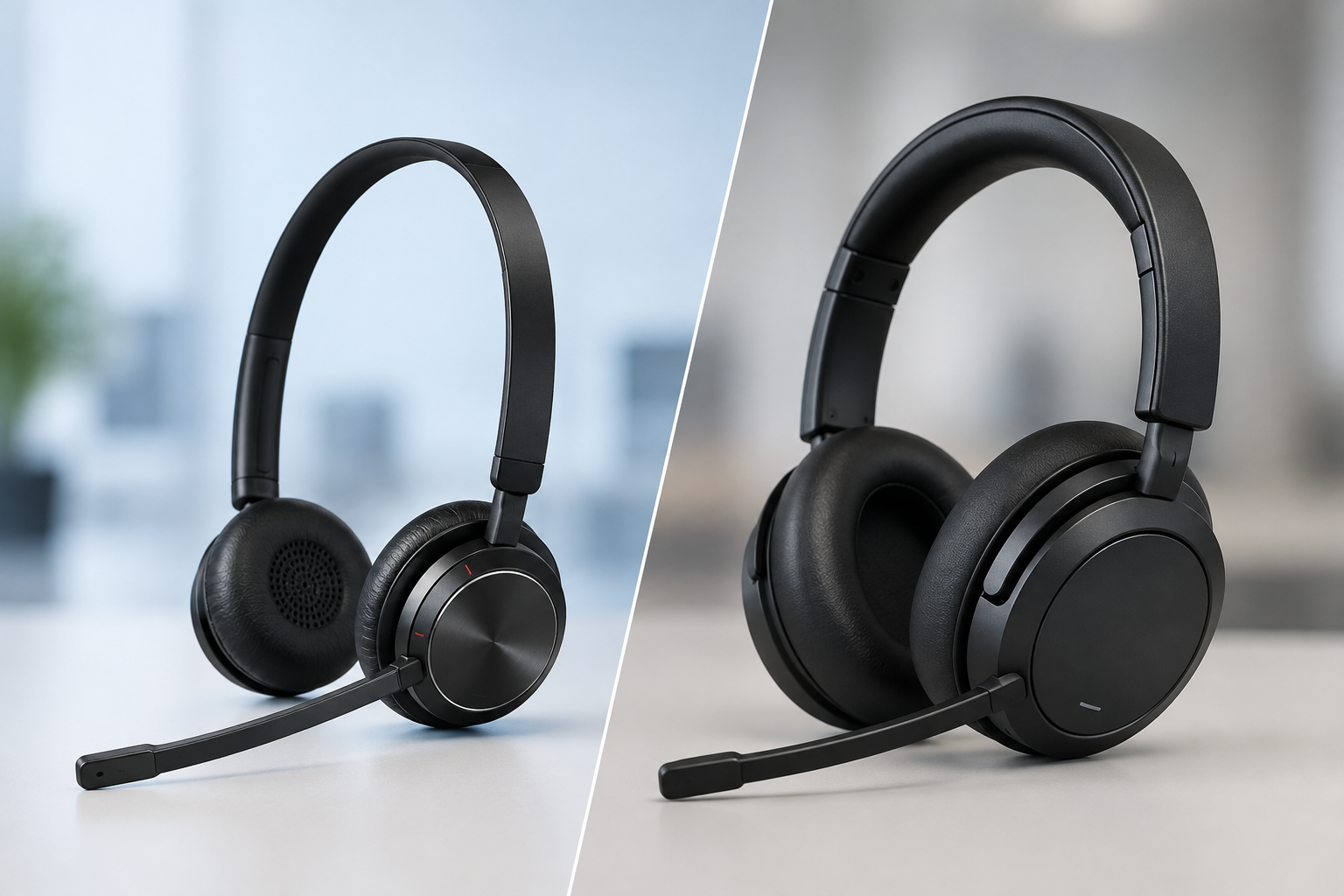
The Evolve3 65 represents a meaningful modernization of the Evolve2 65. So to compare them both simply from the perspective of a datasheet, one could easily argue that the new Evolve3 65 is “better”
You get improved microphone technology, adaptive ANC that works during calls, HearThrough, a reversible microphone, updated comfort, newer Bluetooth and audio technology, plus a replaceable battery and ear cushions.
That's enough for me to consider the Evolve3 65 a legitimate generational upgrade rather than a cosmetic refresh.
But if you already have an Evolve2 65 and it's comfortable, the battery is still performing well, callers hear you clearly, background noise isn't causing problems and the headset connects to everything you need, why replace it just because there's a newer model?
You don't need to.
In fact, we reach the same conclusion in our video: an Evolve2 65 that's still working perfectly doesn't need to be replaced. There's no basis for it.
I'd consider upgrading sooner if you're experiencing a problem that one of the Evolve3 65 improvements actually addresses.
- If callers complain about your background noise, the upgraded microphone system matters.
- If surrounding noise makes it difficult for you to concentrate during calls, ANC during calls matters.
- If you wear your headset for hours and want better comfort, AirComfort matters.
- If you've always wanted to wear the microphone on the opposite side, the reversible boom matters.
And if you're reaching the point where your Evolve2 65 needs replacement anyway, the Evolve3 65 gives you several improvements that should make it the more logical model to consider.
That's a much better reason to upgrade than simply wanting the newest version. On the other hand, if you have some money that's needing to be spent, then the Evolve3 65 is a logical upgrade.
What If You're Buying New Rather Than Upgrading?
This changes the decision.
Someone who already owns a perfectly good Evolve2 65 has to decide whether the Evolve3 improvements justify replacing something that's still working.
A new buyer doesn't have that issue.
You're choosing which platform you want to start with.
Given the Evolve3 65's microphone improvements, ANC capabilities, updated comfort, newer connectivity and replaceable components, I'd lean toward the newer model unless you find the Evolve2 65 at a sufficiently attractive price to make giving up those improvements worthwhile.
There's another consideration for companies.
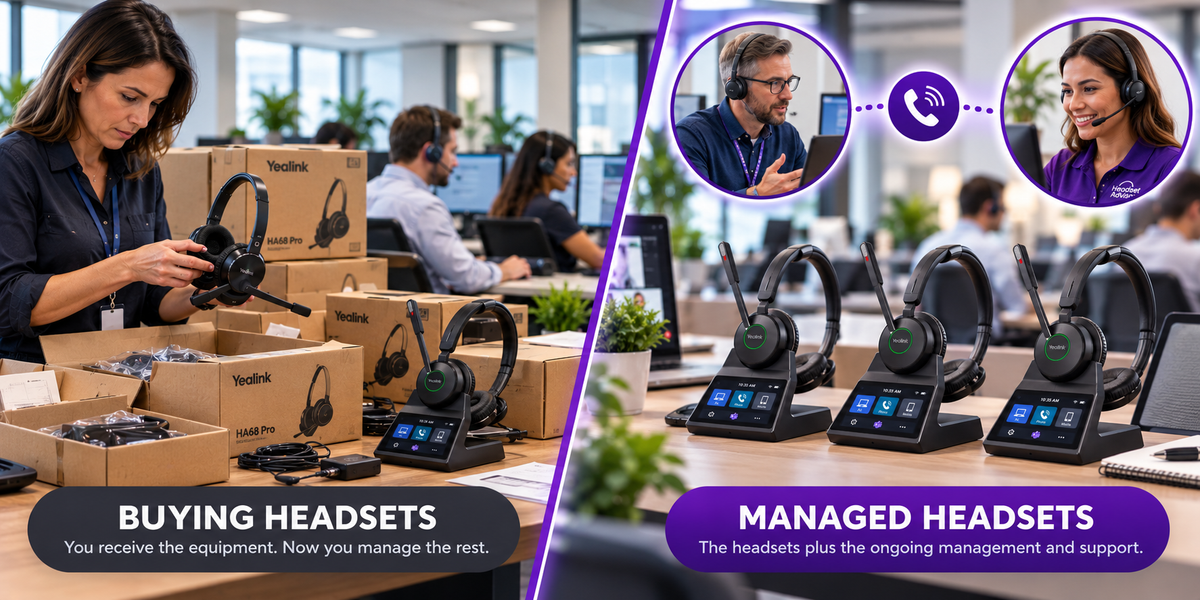
If you're replacing a large number of older headsets, buying all of the new equipment upfront isn't the only option. Headset Advisor's Managed Headset Program combines the equipment with a predictable monthly rate and ongoing headset management. The program includes advance replacement for covered issues, battery and wear coverage, employee turnover swaps and an accidental-damage allowance, helping reduce the equipment-management burden on your internal team.
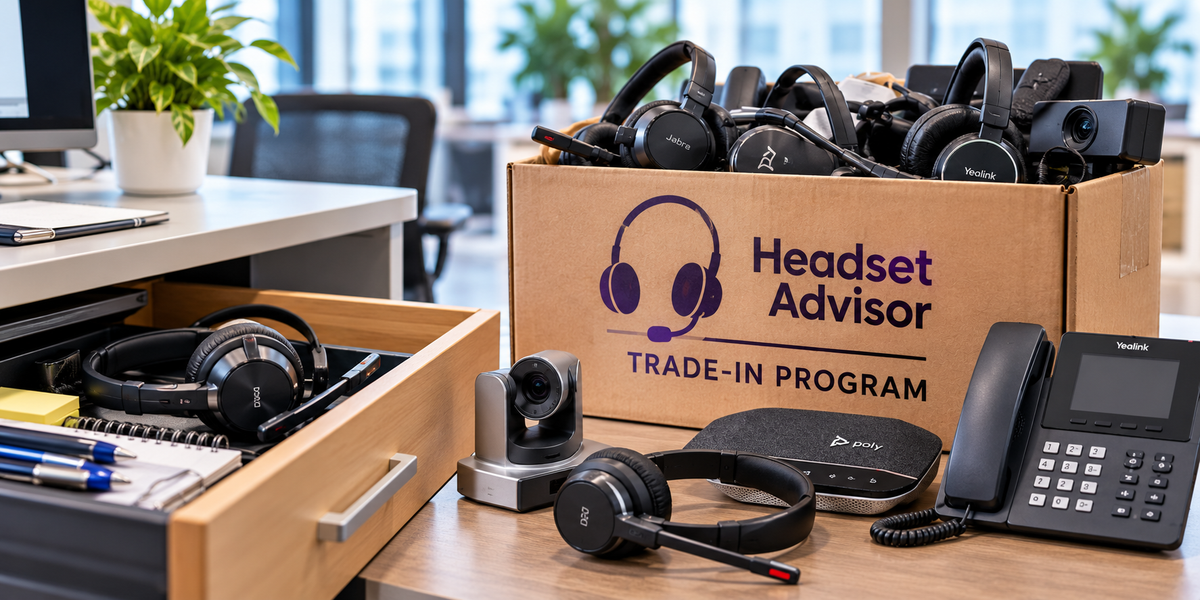
And if upgrading leaves you with a supply of older headsets you no longer need, our trade-in program provides an alternative to putting those headsets in a box and leaving them in a storeroom, or having to pay to have them recycled.
Neither program should determine whether the Evolve3 65 is the right headset for you. They're simply additional options to consider if you've already decided it's time to replace older equipment.
Who Is the Evolve3 65 Best Suited For?
The Evolve3 65 should be a particularly good fit if you spend a significant portion of your day on calls, prefer an on-ear business headset with a dedicated microphone boom, work around some level of distracting noise, and want Bluetooth connectivity to both your computer and mobile device.
But it's not the best choice for everyone.
If you prefer an over-ear design, need significantly greater wireless range, require desk phone connectivity or want a consumer-style headset without a visible boom microphone, there are other business headsets that may fit those requirements better.
That's why I'd avoid looking at the Evolve3 65 simply as "the new Jabra."
The better question is whether its particular combination of features matches the way you work, and aligns with your needs.
Our Take
The Jabra Evolve3 65 improves on the Evolve2 65 in enough meaningful areas that we'd consider it a genuine upgrade.
But better doesn't automatically mean you need it.
When it's time for replacement, though, the Evolve3 65 gives you a number of features upgrades over the Evolve2 65. And those updates aren’t insignificant. For many, they can be impactful.
And if one or more of those improvements solves a problem you're having right now, upgrading becomes much easier to justify.
That's ultimately how we'd make the decision:
Don't upgrade because the model number changed. Upgrade because the new headset gives you something you'll actually benefit from. And when you consider our trade-in, and Managed Headset Program, upgrading has never been easier, and affordable.
Have Questions or Need Some Help?
 Choosing between two similar business headsets isn't always as straightforward as comparing specifications.
Headset Advisor has been helping businesses with their communication needs for over 30 years. If you're trying to decide whether to keep your Evolve2 65, upgrade to the Evolve3 65 or consider something else entirely, one of our knowledgeable Advisors can learn about your equipment, work environment and what you're trying to accomplish, then help narrow down the choices.
The goal isn't to put you into the newest or most expensive headset. It's to help you find the right compatible solution for the way you work.
So don’t hesitate to contact us if you have questions, or need some professional help.
Frequently Asked Questions
Is the Jabra Evolve3 65 better than the Evolve2 65?
The Evolve3 65 introduces meaningful improvements, including a new three-microphone ClearVoice system, adaptive ANC that can operate during calls, a reversible microphone boom, AirComfort design, updated audio and Bluetooth technology, and replaceable battery and ear cushions.
Should I replace my Evolve2 65 with the Evolve3 65?
Not necessarily. If your Evolve2 65 is working well and meeting your needs, there's no reason you have to replace it immediately. The upgrade makes more sense when one or more of the Evolve3 65 improvements addresses something important to you.
Can I wear the Evolve3 65 microphone on either side?
Yes. The microphone boom rotates 270 degrees, allowing you to wear the microphone on either the left or right side. The headset also retains flip-to-mute functionality.
Can the Jabra Evolve3 65 use ANC while I'm on a call?
Yes. This is one of its improvements over the Evolve2 65. The Evolve3 65's adaptive ANC can be used during calls, helping reduce the surrounding noise you hear while talking.
Does the Evolve3 65 have replaceable ear cushions and a replaceable battery?
Yes. Both the battery and ear cushions are replaceable, which can help extend the useful life of the headset when those components eventually wear out.
How much wireless range does the Jabra Evolve3 65 have?
Jabra rates its Bluetooth range at up to approximately 100 feet, or 30 meters. Actual range will vary based on walls, interference and your work environment. If substantially longer wireless range is a priority, a DECT headset may be worth considering.
Can the Evolve3 65 connect to a computer and mobile phone at the same time?
Yes. It supports multipoint with two simultaneous Bluetooth connections and can store up to eight paired Bluetooth devices.
Is the Jabra Evolve3 65 an over-ear headset?
No. It's an on-ear headset, meaning the cushions rest against your ears rather than surrounding them. If you strongly prefer an over-ear wearing style, another headset may be a better choice.